

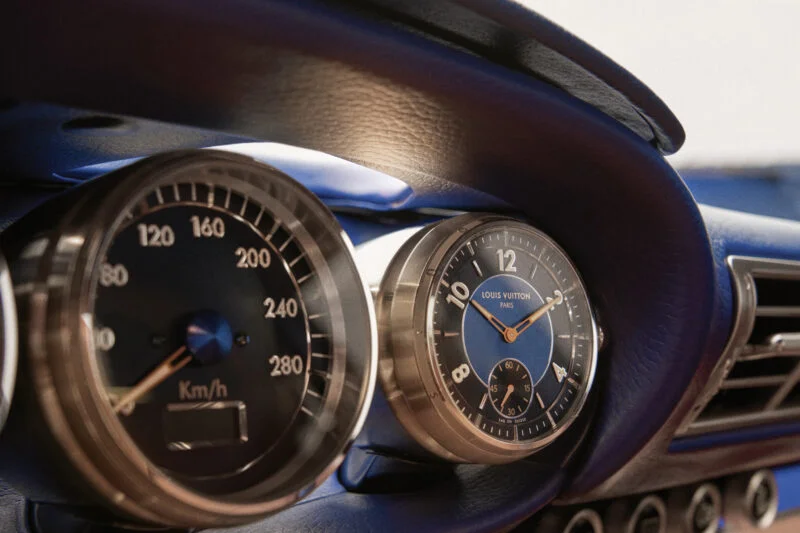
I was going through my closet last weekend, doing that slow September inventory where you pull everything out and pretend you’re a buyer again. That’s what I did for five years at the department store. And I kept thinking about something I read that week: Louis Vuitton put a real mechanical clock inside a Porsche 911. Not a watch. A clock. On the dashboard.
It’s the kind of detail that makes you stop scrolling. So let me tell you about it, and what it actually means for the rest of us who aren’t buying a restomod.

Two cars, two completely different moods
At Monterey Car Week 2026, Singer Vehicle Design — the California studio that has spent 17 years reimagining classic Porsche 911s — showed off its first collaboration with Louis Vuitton. Two cars. Nothing alike, except the obsession with the details.

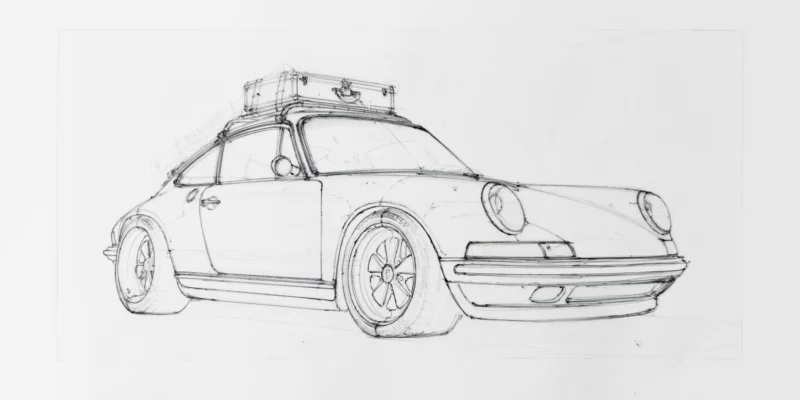
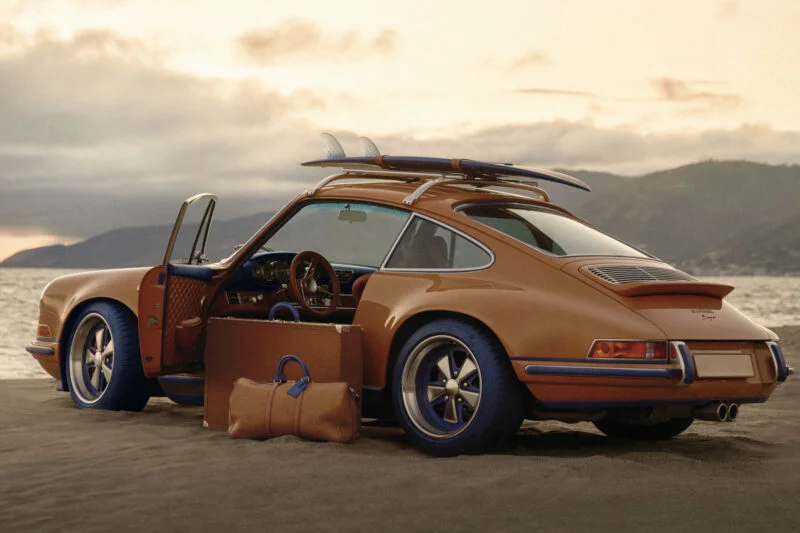
The first is the Porsche 911 Reimagined by Singer – Classic. Saffron bodywork, cobalt blue accents, a roof rack built for luggage, skis, or a surfboard. It reads like a travel bag that learned to drive. That’s not a coincidence — Louis Vuitton was making automobile-specific trunks in the late 19th century, so packing for the road is basically in its DNA.
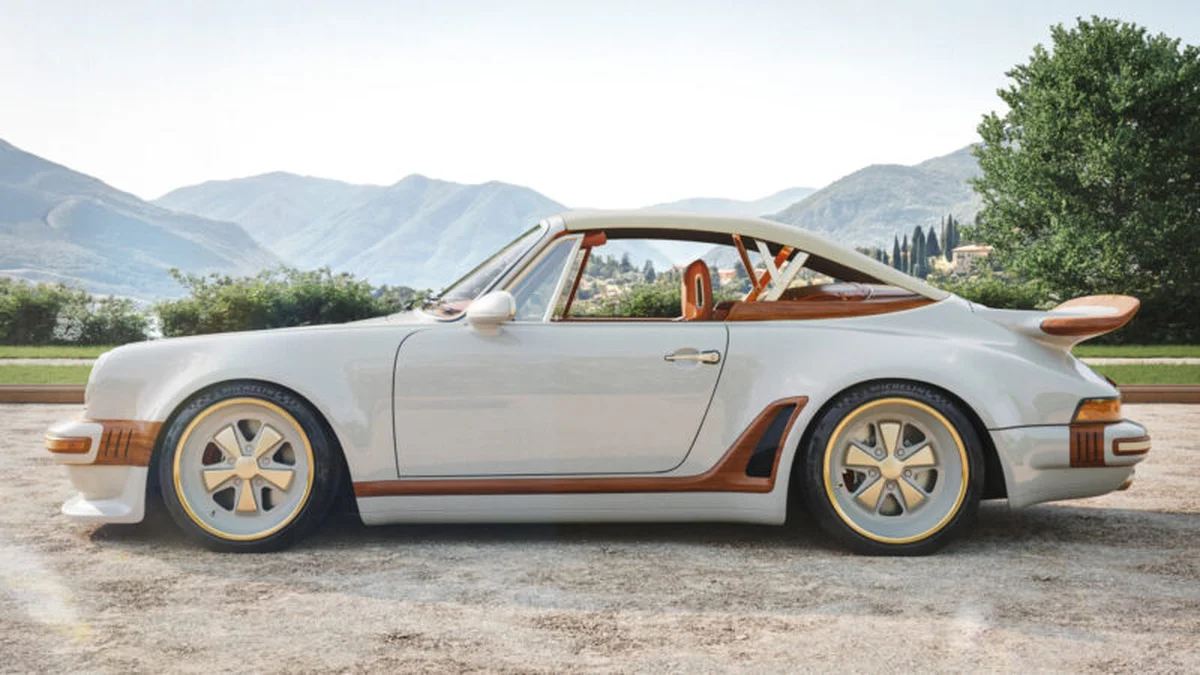
The second is the Porsche 911 Reimagined by Singer – Classic Turbo, and this is where it gets interesting. Conceived with Nicolas Ghesquière, Louis Vuitton’s artistic director of women’s collections, it’s a white cabriolet that takes its cues from classic motorboats. Wood on the bumpers and in the storage areas. A varnished rear luggage deck that looks like the deck of a runabout. And a white soft top stretched into a shape that reads as a sail. I had to stop and think about that one.
How a clock became a year-long project
Here’s the part I love. The whole collaboration started small. A Singer client wanted a Louis Vuitton clock installed in their car. Louis Vuitton came to Singer about building it. Singer chief strategy officer Mazen Fawaz says the conversation quickly grew until the collaboration “encompassed every element of the car.”
Because here’s the thing about a dashboard: you can’t just drop a clock in. La Fabrique du Temps — Louis Vuitton’s watchmaking workshop in Switzerland — built a removable mechanical clock inspired by the house’s signature Tambour watch. But to make it sit convincingly, Singer ended up redesigning the speedometer, tachometer, and the gauges around it. What began as one new component turned into a roughly year-long exercise in rethinking the instrument panel.
That’s the lesson. When you commit to one piece, the whole composition has to follow. Same as a closet. You don’t buy a jacket and hope the rest of the outfit finds itself.
The cabin is where the real craftsmanship lives
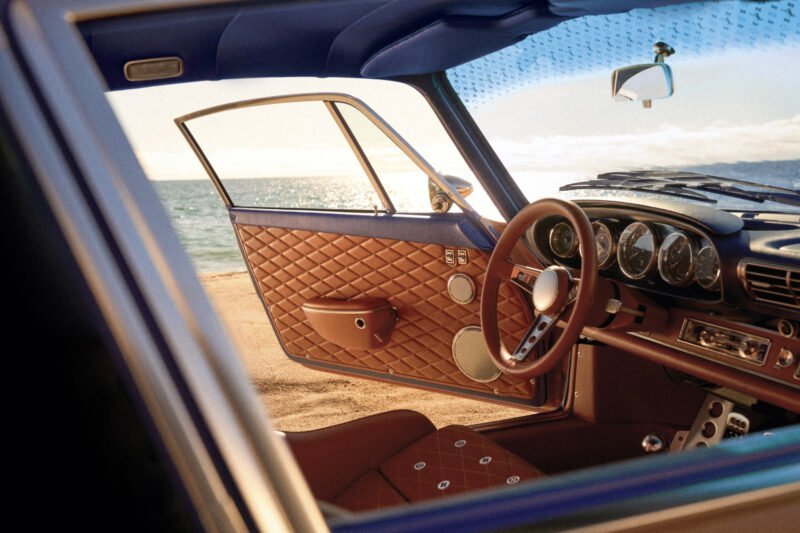
The natural-toned leather in the Classic references the cowhide Louis Vuitton is known for from its luggage work, with yellow stitching and diamond embossing that echo the house’s leatherwork. Even the hardware got attention — plastic components that would normally go unnoticed were swapped for metal switches, locks, vents, and controls, finished with techniques borrowed from watchmaking.
In the Turbo, the clock moves to the center console. Gold-toned gauges and natural leather continue the palette, and the varnished wood compartment behind the seats is shaped around both the luggage and the removable roof. My favorite detail? The gearshift. A leather drawstring borrows the closure of the Noé bag. Small. Playful. Exactly the kind of detail you notice the hundredth time you use it, not the first.

Why a fashion buyer finds this useful
You could read this as luxury news and move on. But I keep coming back to it, because it’s a masterclass in the thing I try to practice with every purchase: one piece, done completely.
Both cars came with bespoke capsule collections — clothing, helmets, driving accessories, and luggage — designed around each car’s design language, with some pieces shaped specifically by how they’d be transported. For the Classic, that meant a Louis Vuitton surfboard and a pair of skis that ride on the roof rack. The car and the wardrobe are one decision, not two.
That’s cost-per-wear thinking pushed to its logical extreme. You’re not buying a car and then separately buying gear. You’re buying one system where everything fits. Most of us can’t afford the car, but we can afford to make one decision like it.
What I take from it
Singer’s founder Rob Dickinson called it a celebration of “the craftsmanship, art, and engineering that lies at the heart of both companies.” Fawaz says if the opportunity to work with Louis Vuitton again came up, they’d “be up for the challenge.” In the coming months the brands plan to take the cars — and pieces of the collections — to more locations around the world.
I don’t own a Porsche. I own a closet that I’m slowly turning into a rotation I can actually use. But this pair of cars made me see the same discipline from both sides: when you treat one object as the anchor, everything else becomes easier. That’s the whole trick. That’s the whole closet. The full story, with more photography, is on Design Milk — the images throughout this post are credited to Singer Vehicle Design.
A note from Lena: I used to buy the trend first and ask questions later. These two cars are the trend that makes you ask the questions first.
You might also like:
- The 10-Piece Edit: a capsule wardrobe you’ll actually wear
- Cost-per-wear: how to stop buying things you never use