I saw a Threads post recently that stopped me mid-scroll: “I don’t have any evidence for it but I have a weird feeling the anti-polyester movement is about to become a right-wing pipeline.”
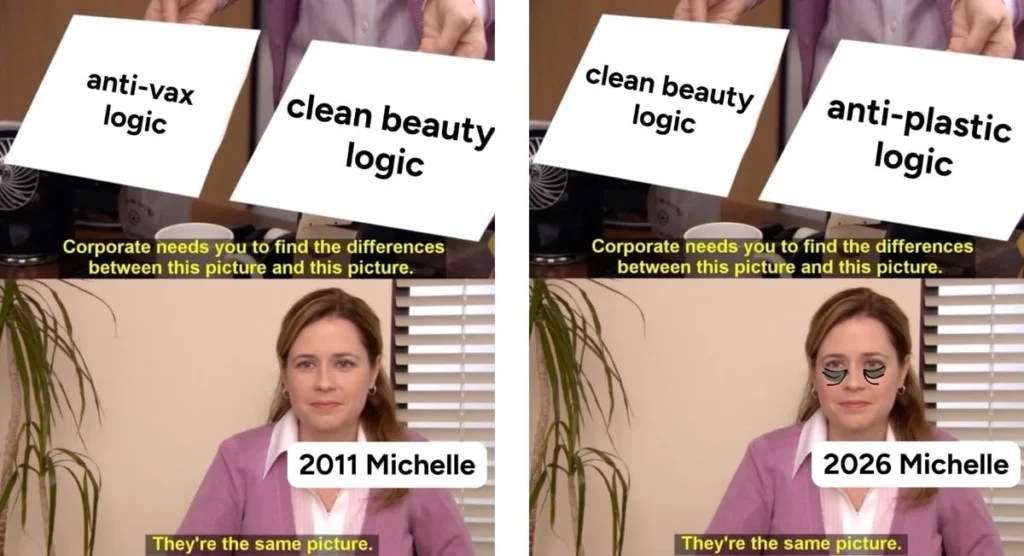
It clicked. It was exactly the same moment I had back in 2011, when I first realised the non-toxic beauty movement could lead straight into anti-vax territory. The arguments follow identical logic. They even demonise the exact same substances — aluminium, formaldehyde.
The current anti-plastic wave gives me those same vibes. Blanket “plastic-free” claims. Fearmongering about microplastics. Brands and influencers treating plastic like it’s the villain in every story.
{{image:cover.webp}}Here is what strikes me most: a lot of people who know clean beauty is pseudoscientific don’t realise those same debunking arguments apply to their plastic messaging too. I noticed this with anti-vax and clean beauty, even among scientists. Outlets like The Conversation publish tons of clean beauty articles, and even Science-Based Medicine has fallen into clean beauty tropes.
I do think we’re using too much plastic. There are legitimate concerns around microplastics and health impacts. But overblowing the concern and switching to “eco” alternatives without looking at evidence actually works against better human and environmental health. Much like how removing “dirty” ingredients leads to outcomes that miss the point.
Here’s the short version: Plastic-free is not automatically better. The science says we need to look at the full life cycle of packaging, not just end-of-life. And many of the studies cited by brands have serious methodology issues.
1. The “natural = good” fallacy
The blanket idea that plastic equals bad and natural equals good extends to bioplastics too — they are made from natural starting materials, so they get a free pass. But where something comes from doesn’t tell you about its effects on health or the environment. Some of the most toxic substances are entirely natural.
Clean beauty parallel: “clean” lists judge natural ingredients far more gently than synthetic ones. Ever heard “if you can’t pronounce it, don’t put it on your face”?
2. Ignoring sustainability science basics
Just as clean beauty only makes sense if you ignore toxicology fundamentals — like “the dose makes the poison” — blanket plastic-free claims ignore the basics of environmental science.
Life cycle assessment, or LCA, is the scientific standard for measuring environmental impact. It looks at every stage: raw materials, processing, manufacture, transport, consumer use, and end-of-life (recycling, disposal, biodegradability).
For many products, end-of-life isn’t the biggest impact. But we tend to focus on it because that’s what we see — recycling bins, landfills, trash islands. Most plastic discussions are almost entirely about end-of-life. People largely ignore climate change, which scientists universally agree is the single biggest environmental threat.
And this is often where plastic packaging wins. One analysis found that switching from plastic to glass, paper, or aluminium would require 3.6 times the material, 2.2 times more energy, and 2.7 times more carbon emissions.
Why? Plastic packaging is lighter — less energy to transport it. It doesn’t break or dent like glass and aluminium during shipping, so there’s less wasted product for the same energy input. And it protects against spoilage better, meaning less product wasted overall.
These aren’t blanket statements — plastic isn’t always the best option. But just as any blanket anti-plastic claim is feeling over evidence, so is any blanket pro-plastic one. Every case needs its own assessment through LCA.
Clean beauty parallel: “free from nasties” claims with no numbers to quantify dose or exposure.
3. Studies with serious methodology issues
A lot of microplastic studies have problems in how they’re conducted that make their results pretty much meaningless. It’s difficult to measure small amounts of any substance accurately, but microplastics have extra layers of complexity — often researchers have good intentions but lack the expertise to run these experiments well.
Take pyrolysis-GCMS (Py-GCMS), a commonly used quantification method. With it, fats look the same as polyethylene unless you carefully correct for the error with other experiments. This means many researchers report finding more microplastics than there actually are. Py-GCMS was the method used in the study claiming we have a spoon’s worth of microplastics in our brains.
Contamination is also massive. Microplastics are everywhere, so lots of studies count microplastics from gloves and lab equipment as coming from the sample itself.
Clean beauty parallel: the “benzene in your sunscreen” story came from a lab with a record of poor measurements. The original “parabens in breast tumours” study had contaminated their samples with parabens from lab materials.
4. Finding microplastics doesn’t mean they cause harm
Finding microplastics in diseased tissue — artery plaque, brains from people with dementia — doesn’t mean the microplastics are causing the disease. Correlation isn’t causation. It could be inverse causation (people with dementia have leakier blood-brain barriers, so everything enters more easily) or unrelated correlation.
Clean beauty parallel: the infamous “parabens in breast tumours” study didn’t even measure paraben levels in normal tissue.
5. Other reasons for using plastic
Beyond environmental impacts, there are practical benefits people overlook when demonising plastic.
Accessibility: Aluminium tubes and glass containers carry a risk of injury, especially for people with limited mobility.
Product protection: Plastic packaging is needed to protect unstable products. It doesn’t dent or break like aluminium and glass, and some components simply can’t be made with other materials.
Clean beauty parallel: parabens are powerful preservatives that require lower amounts compared to alternatives, making them safer for sensitive skin and causing fewer allergic reactions.
6. Science-washing with convenient myths
Many brands and influencers who claim to love science post content and sell products based on anti-plastic myths — supported by cherrypicked evidence and experts.
Claiming to follow science isn’t the same as actually following it. Like any industry, many beauty brands science-wash to move product. Sustainability claims without proper evidence have been deemed misleading by regulators including the US FTC, UK CMA, and Australian ACCC.
Clean beauty parallel: medical doctors fearmongering about ingredients, influencers in grocery aisles citing scientific papers, EWG and Yuka relying on cherrypicked studies.
Watch out for motivated reasoning
I’ve noticed identity-based motivated reasoning and confirmation bias a lot more lately. People accept evidence when it aligns with their political or personal beliefs — this has always been the case with clean beauty, and now I’m seeing it with plastic too.
Mainstream outlets like The Guardian are finally discussing microplastic measurement issues and correcting previous articles on the “brain microplastic” study. But because they quoted a former Dow chemist, people accused them of being bought by Big Plastic — despite also quoting two independent scientists at public institutions plus a response letter from nine European scientists.
As my friend Jen Novakovich said: “Discounting something solely based on funding source or affiliation is actually the opposite of critical thinking.” Looking at conflicts of interest is just one factor. You still have to think about the actual arguments.
A note from Lena
All my posts on environmental misinformation draw heavily from Jen Novakovich’s work — she’s currently doing a PhD on the impacts of environmental misinformation, and her posts are excellent starting points for understanding microplastics, packaging, and greenwashing in beauty.
Consuming less is always the more sustainable option. But if consuming less plastic means consuming more aluminium or glass or paper, the overall environmental impact often goes the other way. The goal isn’t to demonise one material — it’s to look at the evidence before we switch.