
I stood in front of my closet this morning trying on a denim jacket I bought three seasons ago. It still fits, still works, still makes me look pulled together without thinking about it. That is the kind of garment that stays.
A lot of what we call fashion has nothing to do with making things last. But someone like Daniel Byrne does — and his medium just happens to be puppets.
The person behind Puppets Magic Studio
Daniel has been fascinated by puppetry since he was a kid. He remembers being drawn to TV programmes with puppets instead of animation or live action. There was something about watching a physical object come alive on screen that stuck with him.
He started building his own puppets young, learning mostly through trial and error. Resources were scarce back then, so every puppet taught him something new. Later he studied at Central Saint Martins and Goldsmiths, University of London, and by graduation he knew puppetry was the career he wanted to commit to.
Puppets Magic Studio followed naturally. Early commissions helped shape what it is today — a studio that makes custom puppets for film, TV, stage, adverts, and live events. You may have seen their work for Aldi, Vodafone, Marmite, Hofmeister beer, and Tonight at the London Palladium.
{{image:cover.webp}}
The Vestiaire Collective project — puppets made from second-hand clothes
This is where fashion enters the picture properly. Vestiaire Collective commissioned a campaign in which the puppets themselves were constructed from pre-loved clothing, then dressed in more pre-loved pieces.
The design process and material selection evolved together. Daniel’s team developed 2D character designs while collecting and testing fabric samples to nail down each puppet’s personality and look. One character was going to be made from denim jeans, so they sourced a wide range of second-hand denim to find the right weights, colours, and textures.
{{image:image-01.webp}}
The tricky part: clothing fabrics are not designed for puppet making. Most puppets sit around a foam structure that gives them shape, and stretch fabrics fit smoothly over sculpted forms. Denim, leather, and woven cotton have very little stretch at all.
So every pattern had to be carefully designed for the specific qualities of each fabric. The team also made a conscious choice to celebrate the original garments instead of hiding them. Visible jean seams, topstitching, pockets, zips — these became part of each character’s visual language. Those familiar details told the story of where the materials came from and reinforced the campaign’s message about creativity, reuse, and sustainability.
What puppets are actually made from
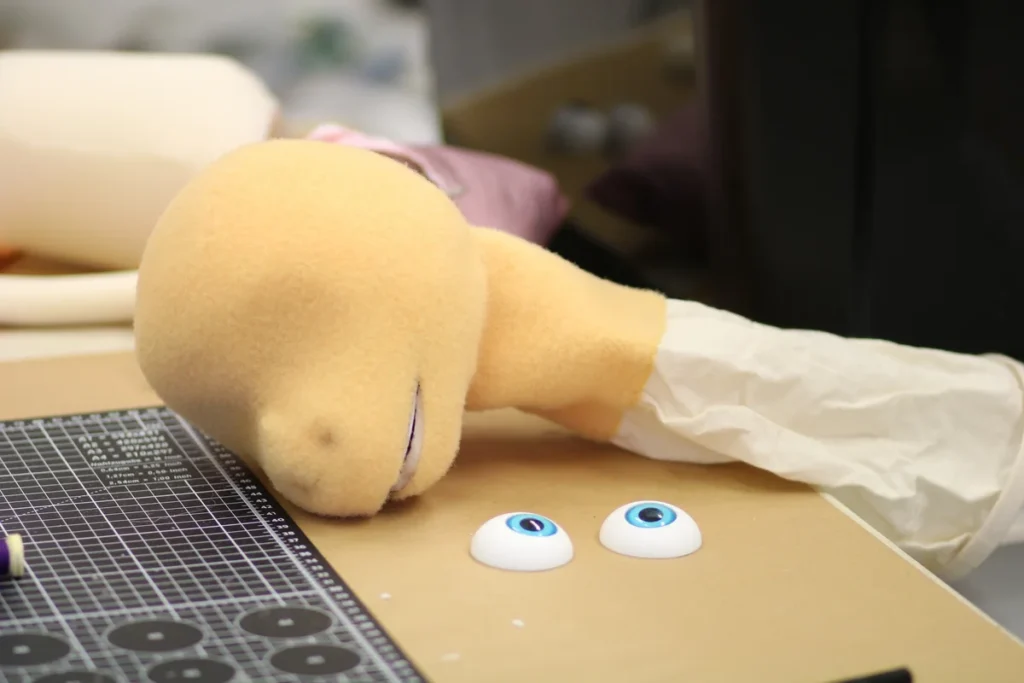
A typical hand-and-rod puppet — the kind you see most often on television — is usually covered in a stretchy nylon fleece. These fabrics are manufactured specifically for the puppetry industry. They are highly flexible and have a dense, fuzzy surface.
{{image:image-02.webp}}
Here is why that matters: when the fleece is carefully hand-stitched, the fibres can be teased and brushed over the seam afterwards. The joins almost disappear. That seamless finish keeps the illusion alive — you see a living character, not an object assembled from separate pieces.
{{image:image-03.webp}}
Sewing is one of the most important skills at the studio. Sewing machines certainly have their place, but much of each puppet is stitched by hand for greater precision over complex sculpted forms. Overlockers are mainly used for costumes rather than constructing the puppets themselves.
Sewing is shared across most of the team, with specialist makers handling textile construction and detailed hand sewing. It is an incredibly collaborative process — every maker brings their own craft skills to create a finished character.
How long does it take to build a puppet?
A bespoke build usually takes at least four weeks, depending on complexity. Television and film often demand tighter schedules, so the studio is used to delivering under pressure when production requires it.
The design timeline varies too. Sometimes a client arrives with a fully developed character ready for fabrication, and the team moves straight into making. Other times they start from a basic concept — exploring personality, proportions, materials, and how the puppet will perform on screen. In those cases, the design phase can take longer than the build.
Daniel loves that no two projects are ever quite the same. Every commission brings its own creative challenges, whether designing from scratch or finding the best way to bring an existing concept to life.
{{image:image-04.webp}}
What happens to puppets after they’re done?
Once a puppet has been used on a production, it usually stays with the production company. Sometimes it ends up displayed in an office if the character became important to a campaign.
Daniel recalls one programme for ITV from years ago — during a major office relocation, they asked if he’d like the puppets back since everything needed clearing out. It is quite unusual, but nice to have a reminder of a project you enjoyed being part of.
The studio rarely dismantles a finished puppet. Parts get reused only when an early prototype is no longer needed. Puppets are practical effects performed by puppeteers, so they face the same wear and tear as any well-used costume or prop. Longer productions need regular maintenance to keep puppets performing well and looking their best on camera.
The overlap between fashion and puppetry
This is the part I found most interesting — because it mirrors everything I learned during five years buying for a department store. Fashion plays a vital role in puppet design. A puppet’s costume is often one of the first things an audience notices, offering immediate clues about personality or role.
From a making perspective, building a puppet has many similarities to designing and constructing clothing. Pattern drafting connects the two directly. Fashion designers draft patterns for garments that fit the human body; puppet makers develop patterns for fabric skins and soft structures that must fit precisely. Both require an understanding of shape, proportion, and three-dimensional construction.
{{image:image-05.webp}}
Movement matters in both disciplines. A fashion designer thinks about how a garment will drape and move with the body. A puppet maker considers how the character will perform and how it feels for the puppeteer to manipulate it. Thoughtful design balances aesthetics with function — making sure the final piece looks good and actually works.
{{image:image-06.webp}}
Frequently asked questions
Does Puppets Magic Studio offer open days or workshops?
They would like to, but film work usually comes with NDAs, so projects need to stay under wraps. They sometimes accept interns depending on workload at the time.
Can you commission a puppet from them?
Yes. A bespoke build takes at least four weeks, though timelines depend on complexity and whether the design is already developed or starting from scratch.
Where can I see more of their work?
Their website has a full portfolio: Puppets Magic Studio website. You can also follow them on Instagram.
A note from Lena
I think about cost-per-wear a lot — how many times you actually pull something from your closet before it fades into the back. Daniel’s puppets made me see that same logic in reverse: giving old garments a second life, then dressing them in more second-hand pieces. Fashion and puppetry both ask the same question — what story does this fabric tell? If anything, I’ll be looking at my denim jacket a little differently next time.
Related reads: The 10-Piece Edit: Capsule Wardrobe Basics · How to Shop Secondhand Without the Guesswork