
Tunisian crochet almost talked me out of myself. I bought the long hook, cast on a chain of thirty, and by row four I had a fabric that curled, gapped, and looked like it needed a therapist. The technique itself isn’t hard. The friction is in the details — the hook size, the grip, the way that first stitch always comes out loose. Once I stopped fighting those details, the project started to look like something I could actually finish.
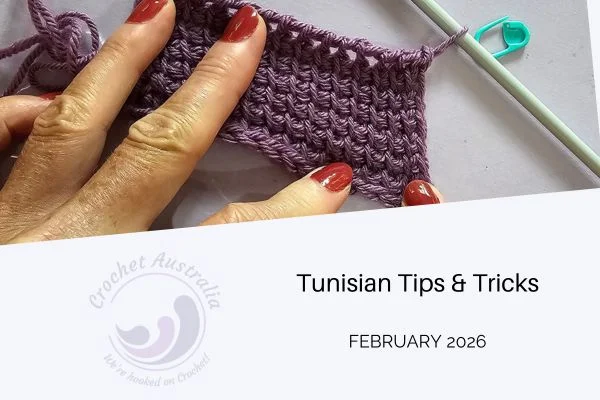
One thing to know before you start: Tunisian crochet has a forward pass and a return pass. You never turn the work, and you’re looking at the right side the entire time. Both passes together count as one row. That’s it. That’s the whole mental model, and almost every tip below exists to keep you inside it.
1. Pick the right hook — length and size
Tunisian hooks are longer than regular crochet hooks, with a shaft like a knitting needle and a stopper at the end. They come in lengths from 25cm to 100cm, and straight hooks generally top out around 35cm. Beyond that, you’re looking at flexible-cable hooks, which are actually easier to live with once your row grows long. Pick a length that fits the number of loops you expect to hold in a row, not the pattern you’re doing today.
On size, go up. The stitch structure needs a hook 2–2.5 sizes larger than you’d normally use for that yarn to get a similar drape. If you’d normally use a 4mm hook on sport weight yarn (what’s called 8 ply in Australia), a 6mm or 6.5mm Tunisian hook is where you start. This single change did more for my drape than anything else on this list.
If you think you’ll branch out into wide projects or color work, double-ended hooks and interchangeable hook sets are worth it — you can swap cable lengths and hook heads instead of owning a drawer full of fixed hooks.
2. Change how you hold the hook
The length changes your grip. For the forward pass — the pickup row — I hold the hook more like a knife. For the return pass, it becomes a pointer. Both feel wrong for a day, then they feel like the only way.
One exception: the starting chain. Make that chain with a regular crochet hook the same size as your Tunisian hook. It’s faster, and it keeps the foundation honest before the long hook takes over.
3. Fix the loose first stitch with a marker
Here’s the one that made me feel like I was doing everything wrong: every row, that first stitch comes out visibly looser than the rest. The cause is the leftover loop from the previous row getting stretched while you pick up the rest. The fix is a stitch marker.
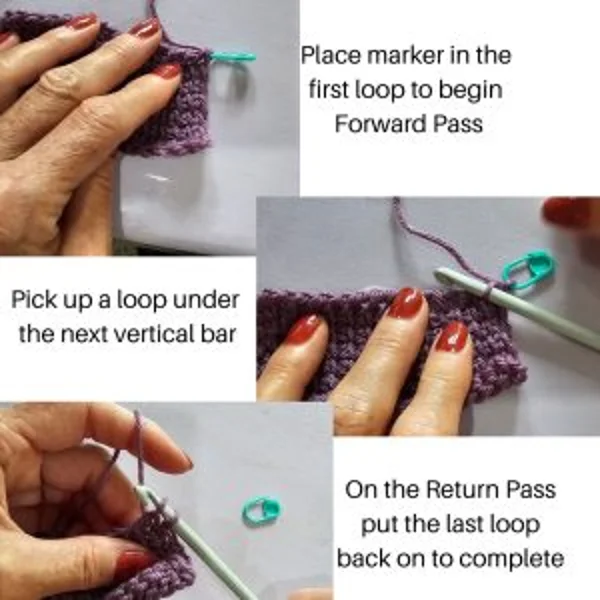
Before your pickup row, slip that first loop off the hook and onto a marker. Pick up the rest of your loops as normal, work the return pass until you reach the marker, then swap: take the last loop off, put the marker loop back on, then the last loop on, and complete the final stitch. The first stitch stops ballooning. Small move, visible difference.
4. The last stitch needs two bars
The opposite problem lives at the end of the row. If you pick up the last loop under only the front vertical bar, it comes out loose too. Pick up under two bars instead — the front bar like every other stitch, plus the bar immediately behind it. It makes a small V along the side of the work, and the edge reads clean instead of gappy.
5. Pull the work down to find the bar
When you’re new, the front vertical bar you need to hook under is genuinely hard to see. Don’t strain your eyes. Pull the work gently downward and the bars line up. It’s the cheapest visibility fix in the whole craft.
6. Count loops, not stitches
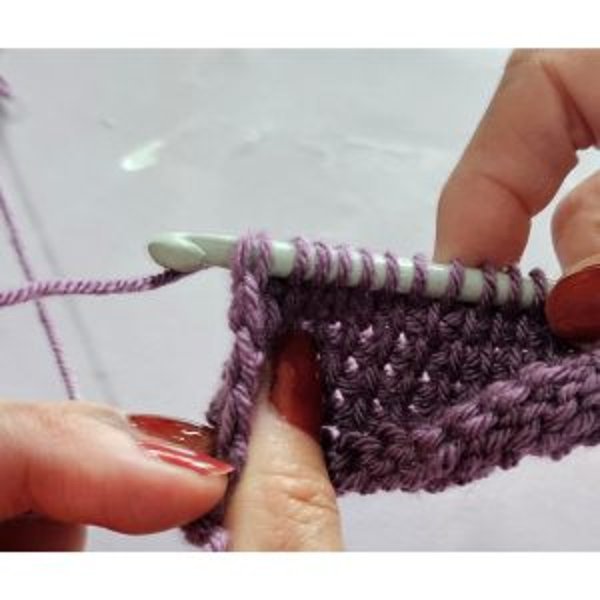
With regular crochet you count stitches once they’re done. In Tunisian, the stitch structure hides where one stitch ends and the next begins. The workaround is to count while the loops are still sitting on your hook, before the return pass. Each loop is one stitch. Counting at that moment is the only time I trust my numbers.
7. Why the top row always looks gappy
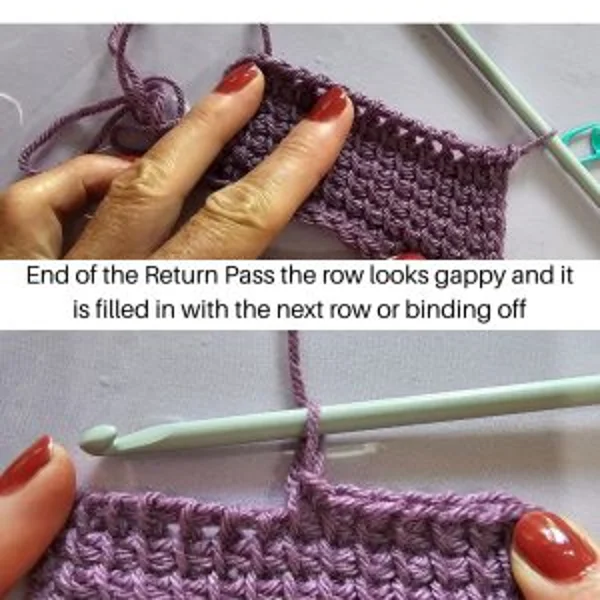
Finish a return pass and compare that row to the ones below it. It looks holey. Loosely knit, unfinished, like a draft got in. That’s normal. The stitch isn’t complete until the next full row runs through it. When you’re at the end of your pattern, you don’t just stop — you bind off, which is basically a row of slip stitches. Don’t pull them tight, or you’ll cinch the edge and undo the even tension you just built.
8. Curl is expected. Manage it, don’t fight it.
Early rows will curl up at the edges. That’s the nature of the fabric as it’s forming, and it eases as the work grows and is blocked. You can’t eliminate it entirely, but the hook-size advice in tip 1 does most of the heavy lifting. If you want a deeper dive on blocking out curl, search for dedicated Tunisian curl-removal techniques — wet blocking in particular helps a lot.
Frequently asked questions
Can I use a regular crochet hook for Tunisian crochet?
You can start small projects that way, but the long shaft and stopper are what keep dozens of loops from sliding off mid-row. For anything wider than a small swatch, get a real Tunisian hook.
What if I don’t have a 6mm or 6.5mm Tunisian hook?
Use the nearest size you have and test drape on a swatch. The rule of thumb is 2–2.5 sizes up from your normal hook for that yarn, and drape is the thing you’re actually chasing, not the number on the hook.
Why does my fabric look gappy or loose in places?
Two culprits: the first stitch of each row (fix it with the marker method) and the last stitch (pick it up under two bars). Both are one-move fixes, and both show up in the photos above.
A note from Lena
Tunisian crochet doesn’t reward speed, and that’s the appeal. It’s the craft equivalent of the slow, intentional pieces I keep in my rotation — not the trend I’ll regret by next season. Start with a swatch, keep the hook two sizes up, and let the gappy top row be gappy. It fixes itself.
Related reads: how to block a crochet project without shrinking it, and the beginner’s guide to crochet hook sizes.